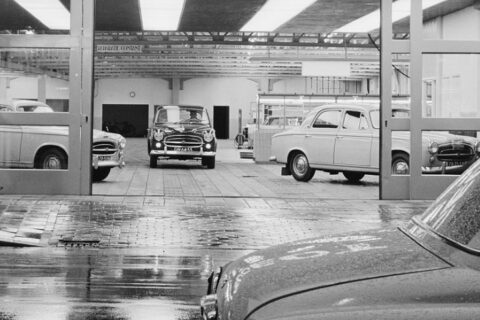
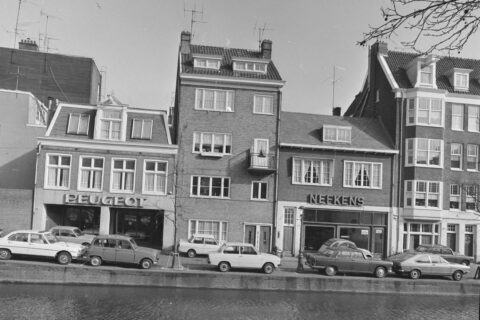
In 1948, after the Alpen Tour Rally, Maurice Gatsonides, the most famous Dutch rally driver at the time, discussed the absence of international rallies in the Netherlands with French driver Marc Angelvin. Gatsonides pointed out the lack of mountains, but Angelvin suggested that tulips could be a beautiful rally symbol. In 1949, the Regional Automobile Club West organized the ‘Rallye des Tulipes’, which originated in France and led to the success of the Tulpenrallye with 159 teams. Gatsonides was involved, but the hard work was done by Lex van Strien, Jos van Calsteren, Jaques Lioni, and ‘Mr. Tulpenrallye’ Piet Nortier.
The first Tulip Rally in 1949 was a star run with no fewer than 159 cars at the start, which made the organisation enthusiastic. Challenges for the classification were difficult at the beginning, but the event grew. And Peugeot was there from the start. In the archives we initially find photos of the 203 and from the end of the 1950s onwards, the 403. In 1953, Count Hugo van Zuylen of Nijevelt and Frans Eschauzier became the first Dutch winners. From 1954 onwards, the rally developed into an increasingly challenging event and after 1959 the number of approach routes was reduced.
The Tulip Rallye became famous in Europe in the 1960s, with Monaco as a turning point. Commercial interests led to fierce competition. In 1965, an amateur class was introduced, and financial challenges arose in 1966. New sponsorship and professionalization followed. In 1968, the Tulip Rallye was one of the most important rallies of the European Championship. Peugeots were less often seen on the starting line and Porsches, Minis, MGs and Triumphs became the new rally horses with which a rally could be won.


In 1969, vanwege ziekte van Piet Nortier, verandert de rally van start- en finishlocatie en verliest het de EK-status. Financiële moeilijkheden en veranderende regelgeving blijven een uitdaging. In 1973 wordt een nieuwe organisatie opgericht, maar het initiatief mislukt. In 1974 en 1975 worden geen Tulpenrallyes georganiseerd. Vanaf 1976 neemt de STAR-organisatie de rally over, met drie succesvolle edities. Discussies over proevenverkenning leiden tot protesten. Na 1978 stopt STAR, en de AMAC neemt het over. Onder leiding van Kees Stoel wordt het evenement verder geprofessionaliseerd. Na moeilijkheden in de jaren ’80 eindigt de Tulpenrallye in 1991.
The AMAC decided to organise rallies for the FIA European Championship for classic rally cars, but after two editions this concept was stopped. In 1994, the rally returned as a regularity rally for classic cars from Noordwijk. The concept was a success, and the third heyday began, in which recreational racing became popular. In 1999, 50 years of the Tulip Rallye were commemorated and the route ran from Noordwijk to the Funkturm in Berlin and from there back to Noordwijk.
In 2013, the sixtieth edition was celebrated with a route from Noordwijk to Nice. Kees Stoel passed away in 2015. In recent years, the 203 has returned to the field of participants. Especially because the Tulip Rallye has acquired a retro character. The Tulip Rallye remains a valued event with a rich history and Peugeot is no exception!