Did you know Peugeot once made boats? At the 1889 World’s Fair in Paris, where Armand Peugeot presented his steam tricycle, he was fascinated by two boats, the “Violette” and the “Passe-partout,” sailing on the Seine. These were equipped with a V-twin engine, designed by German engineer Gottlieb Daimler, which ran on petroleum gas. The engine was originally intended for land transport and was produced under license in France by Panhard & Levassor. Armand Peugeot kept this concept in mind, and from 1890 onward, this engine would eventually play a role in the development of his first self-propelled cars, which were officially called “automobiles” in 1896. But could he have imagined back then that he would one day motorize boats?
In 1883, Armand Peugeot fell in love with Morgat, a small town in Brittany, where he developed a seaside resort. The Franche-Comté industrialist had since harbored the idea of motorizing the fishing boats there.
On November 26, 1904, Armand Peugeot entered into a partnership with Tony Hubert, a small motorcycle and car manufacturer, and founded the company “Armand Peugeot – Tony Huber et Cie” in Billancourt. Its primary purpose was the construction of marine engines. The first fishing boat equipped with an engine and sails was named “Le Comtois” and was launched in the port of Morgat. Armand Peugeot also had another sailing experience there, unfortunately sinking a tuna boat after only two voyages.
Like other car manufacturers of the time, the Société Anonyme des Automobiles Peugeot supplied shipyards with engines, derived from their cars, for so-called “car boats.” Races were even organized in popular seaside resorts like Monaco. In 1904, the Peugeot III boat won the Cruiser Cup there for boats from 6.50 to 8 meters.
In 1907, Peugeot presented marine propulsion systems in Paris, including an 8 hp single-cylinder and a 4-cylinder engine in three versions ranging from 10 to 16 hp. One of the highlights was a 15-seat marine launch that won first prize in the 1906 Rouen Cup competition.
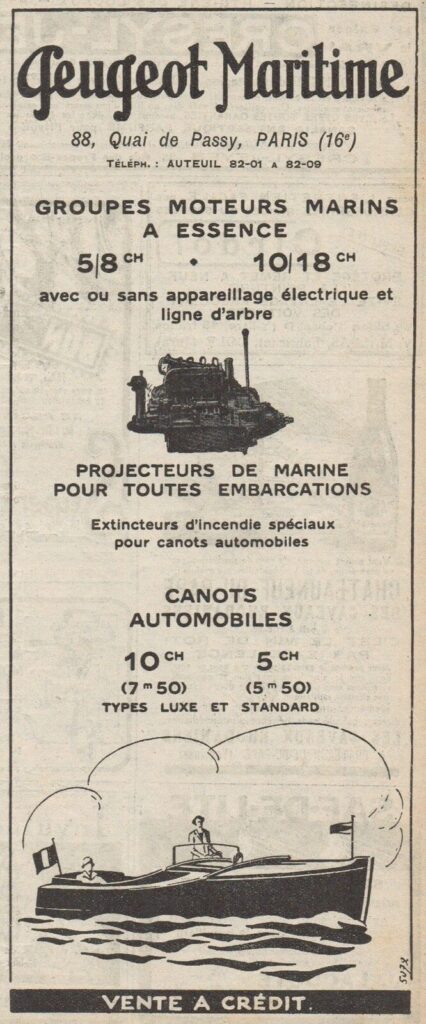
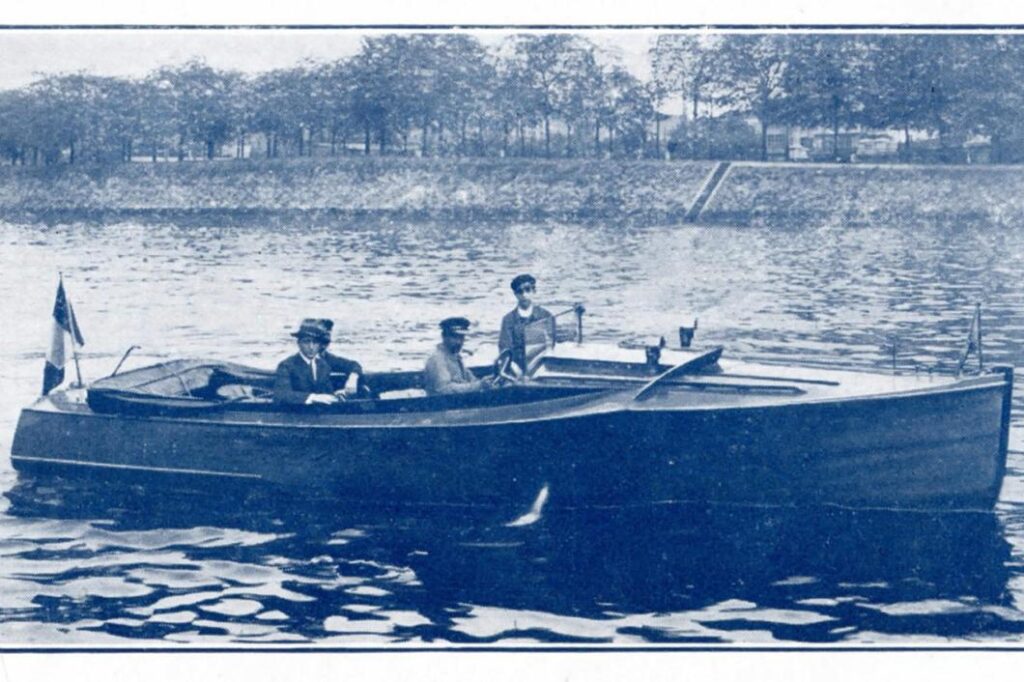
Although the production of these marine engines and boats was relatively marginal compared to that of cars, Peugeot’s maritime activity was interrupted during World War I and did not resume until 1921. In early 1925, Lucien Rosengart, then Peugeot’s general manager, founded the “Société Peugeot Maritime” in Paris, with the aim of producing marine engines, rowing boats, and mechanically propelled pleasure boats. Rosengart had ambitious plans and wanted to utilize France’s 15,000 km of inland waterways to create a new form of transportation. In 1926, five engines were delivered, and two 7.50-meter boats, equipped with a 10-hp engine derived from the Type 177, achieved 12 knots (22 km/h) on the Seine during their initial tests. That same year, research began on a larger unit, powered by two 75-hp engines, intended for navigation with 250 to 300 passengers on Lac du Bourget.
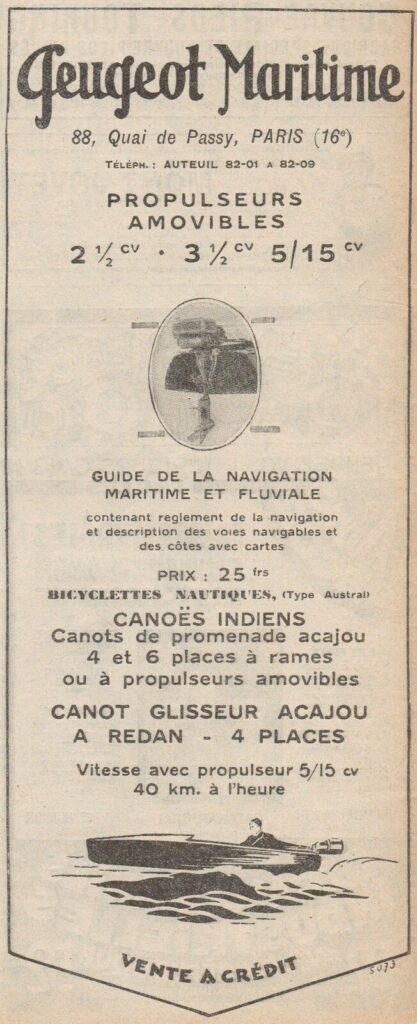
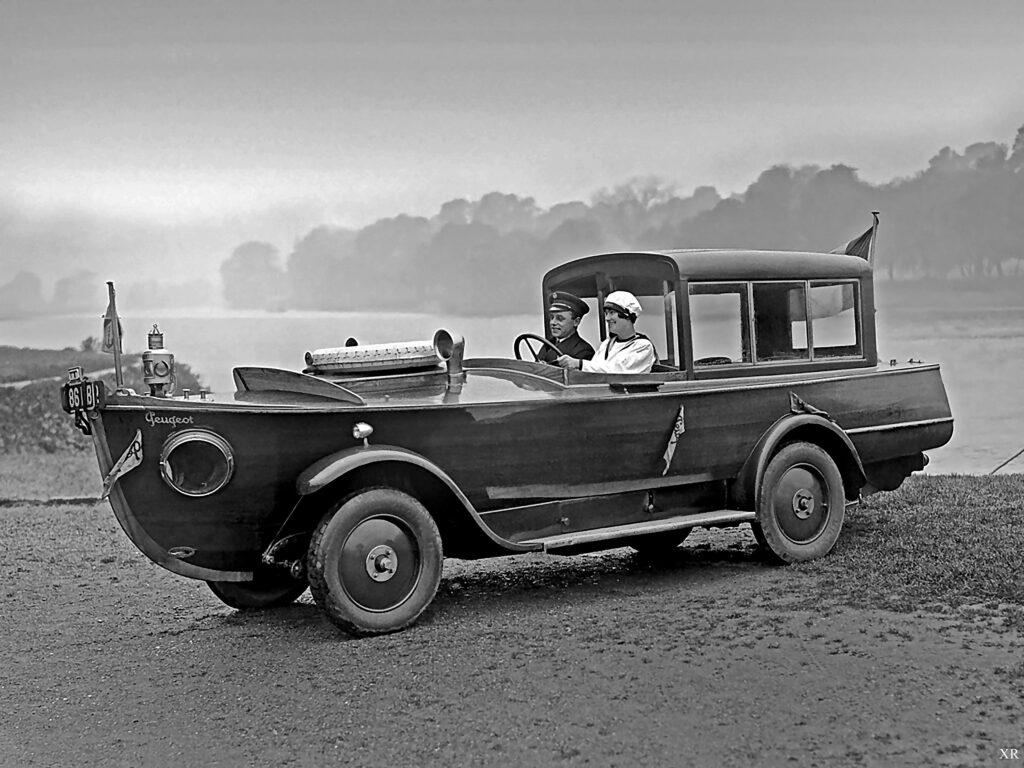
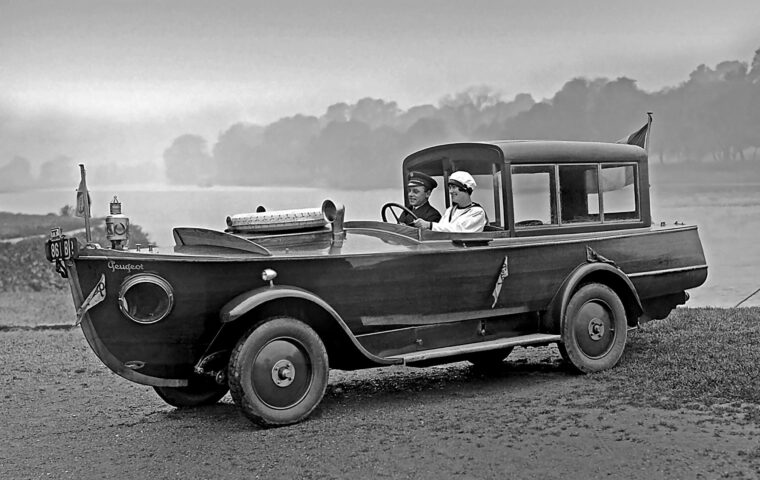
Rosengart also produced low-powered outboard motors under the Peugeot brand, capable of propelling 5- to 6-meter boats at speeds of 10 to 14 km/h. In 1926, a boat hull was even mounted on the chassis of a Peugeot Type 177 M car, which was used for a promotional tour of France.
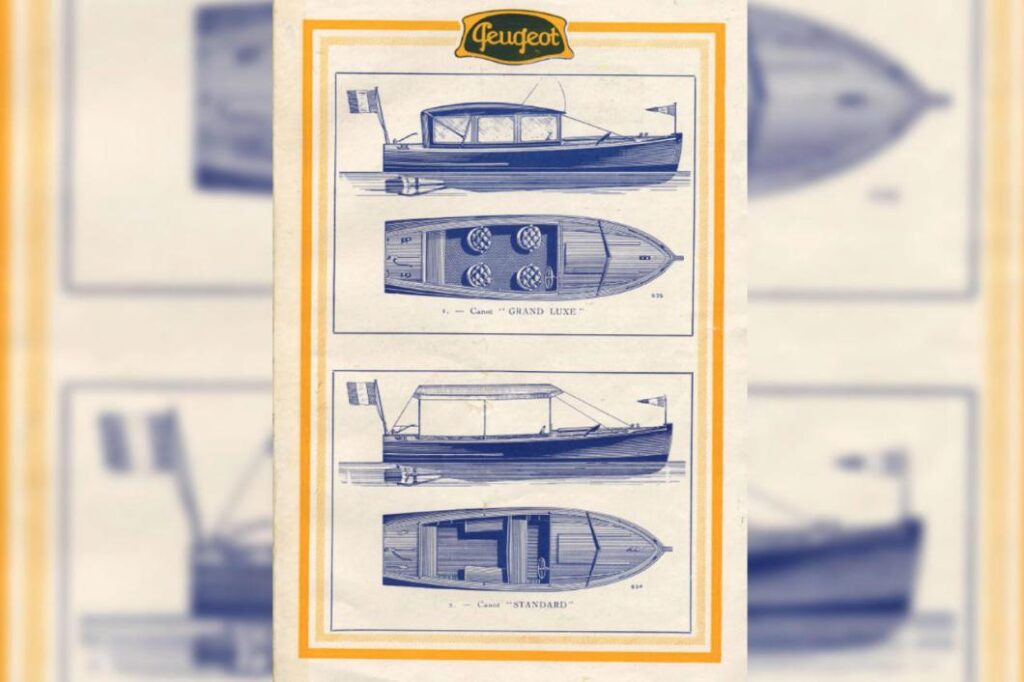
To promote its products, Peugeot Maritime produced elegant posters depicting the beauty of river tourism and the speed of sporty cruising at sea. The company also distributed maps and navigation guides and offered boating lessons in Paris.
In October 1926, Lucien Rosengart organized the first “Boat Show,” where Peugeot Maritime presented two versions of a “luxury” boat. The varnished hulls of these boats, made of mahogany, rivaled the prestigious American, English, or Italian runabouts. Prices varied; the standard version of a 5.50 m boat cost 12,500 francs, while a Peugeot 5 CV car equipped with the same engine cost 21,980 francs.
Despite these promising developments, internal discord led Rosengart to leave the company in January 1928. However, at the 1928 Boat Show, Peugeot Maritime boasted a tripling of its sales in a single year, with boats equipped with 25/40 hp or 30/45 hp engines sold in 14 countries.
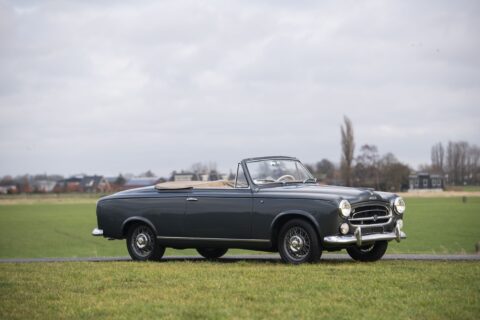
Peugeot’s nautical activities ended in 1930, when the company focused its investments on the “Grand Sochaux” project and the financial crisis of the time made it necessary to prioritize. This “necessary” sacrifice contributed to the success of the Peugeot “201.” Peugeot continued to sell its “marine” engines, however, and in the 1950s, some boats were even equipped with a “403” engine. In the 1960s, tourist and fishing boats were powered by the Peugeot Diesel “Indénor.”